
For many employees, the daily commute to the office is becoming harder to justify. Sitting in traffic and paying for petrol can feel unnecessary when much of their work can be done from the comfort of home.
This doesn’t mean the office has lost its purpose. Its role is simply evolving. It’s a shift reflected in workplace research. Microsoft’s Work Trend Index found that over 70% of workers want flexible remote work options to continue, while more than 65% still want more in-person time with their teams. In other words, employees still see value in the office, but only when it offers something meaningful beyond a desk.
Research from CBRE supports this, stating that the main reason employees come into the office is for collaboration, social connection, and access to better workspaces and technology.
For Australian businesses, the return-to-office conversation is no longer about forcing employees back to their desks. Instead, the focus should be shifting toward designing environments that support the kinds of work that benefit from being together.
Forward-thinking companies are already moving beyond the traditional “desk farm” layout toward activity-based workplaces built around micro-zoning. The result is an office designed around how people actually work today – one that employees will actually make the effort to visit.
The Outdated “Desk Farm” Office and Why It No Longer Works
For decades, the ‘traditional’ office followed the same basic formula: rows of desks, assigned seating, and a handful of private meeting rooms. This layout made sense in the pre-hybrid, remote-working era, when most work was done individually, and employees spent most of their day at their desks.
Today, however, the way people work has changed. Employees are much more active, shifting between focused work, collaborative discussions, and hybrid meetings. A single desk set-up isn’t designed to support all of these activities effectively.
Workplace research also reflects this shift. A Deloitte Australia survey found that over 60% of employees say the office needs to offer better collaboration environments to justify commuting.
As a result, many organisations are reconsidering office design. This shift is where activity-based workplace design and micro-zoning begin to play an important role.
What is Micro-Zoning in Workplace Design?
As organisations rethink how their workplaces can support modern work activities, many are moving towards a micro-zoning approach.
Micro-zoning involves dividing the office into small, purpose-built environments rather than the assigned-desk setup, with each zone designed to suit different activities.
The concept is closely related to activity-based working (ABW), a workplace strategy that first emerged in the Netherlands and Scandinavia in the 1990s. Instead of assigning everyone a permanent desk, ABW encourages employees to choose the environment that best suits them.
Micro-zoning supports that strategy and refers to how the office is physically designed to support it.
In a micro-zoned office, employees might move between quiet areas for concentrated work, collaborative hubs or pods for team discussions, and technology-enabled meeting spaces designed for hybrid communication. This flexible set-up allows the workplace to support the different ways people work throughout the day.
This approach is proving very effective, with measurable benefits. A study by the Property Council of Australia found that companies that redesigned offices around flexible spaces reported improved employee engagement and better utilisation of the office.
Instead of a static layout, micro-zoning helps create workplaces that support productivity and enhance overall employee experience.
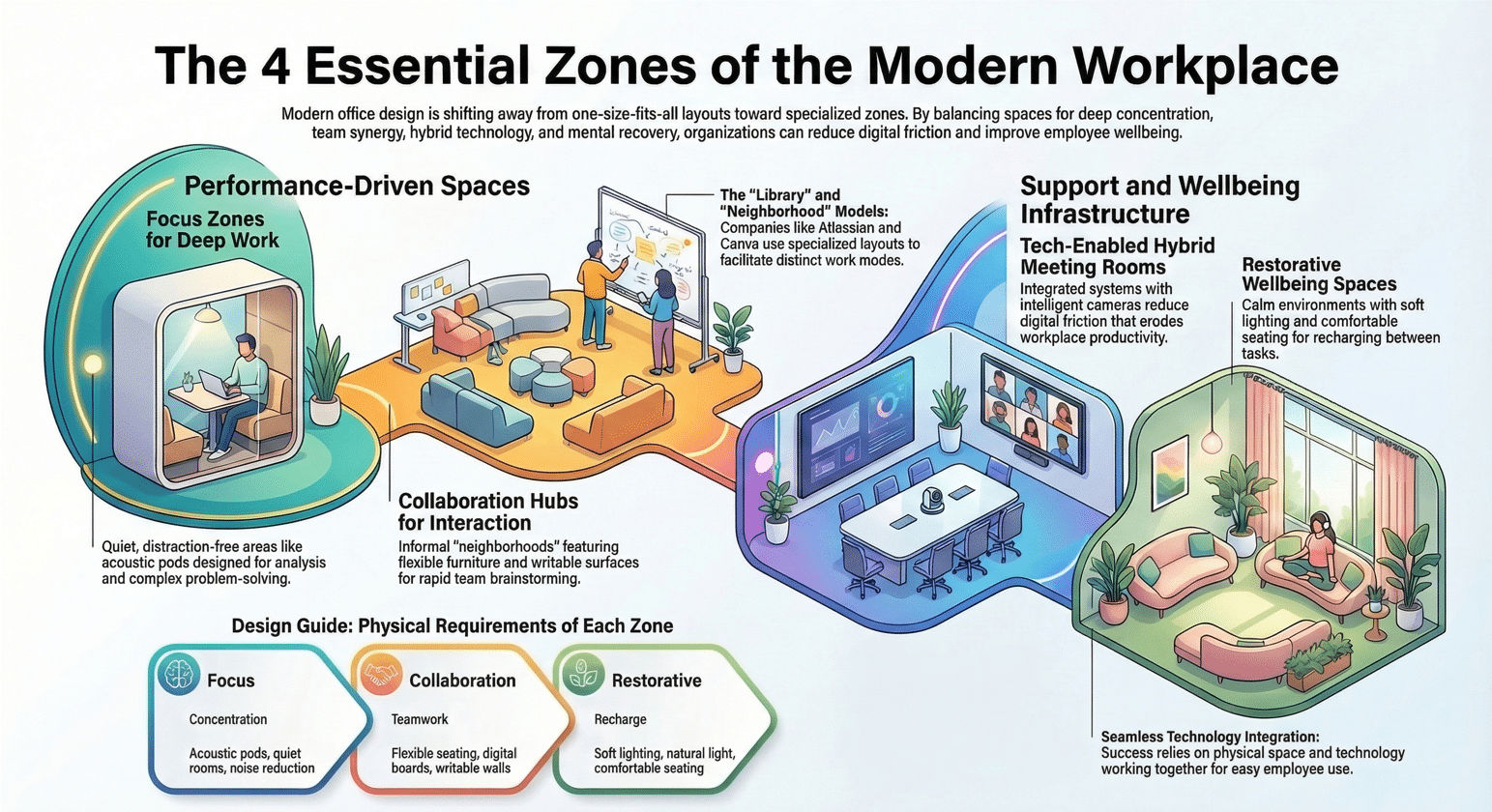
Four Essential Zones of a Modern Workplace
If you’re thinking about redesigning your office space, you may be wondering where to start. While every organisation’s needs are different, most modern workplaces include a combination of the following zones.
1. Focus Zones: Spaces for Deep Work
Despite the emphasis on collaboration, quiet spaces for concentrated work are very much needed in the modern workplace.
Focus zones are designed to minimise distractions and allow employees to complete tasks that require their full, undivided attention, such as analysis, planning, writing, or complex problem-solving.
Software company Atlassian has introduced quiet “library-style” rooms within its offices, designed for focused work.
Focus zones may include acoustic work pods, quiet rooms, or dedicated workstations designed to reduce noise and physical distractions.
2. Collaboration Hubs: For Team Interaction
One of the main reasons people choose to come to the office is to work alongside their colleagues. Informal collaboration hubs allow teams to gather quickly, share ideas, and work through challenges together.
At Canva’s Sydney headquarters, office areas are designed into team “neighbourhoods”. These spaces include shared project tables, brainstorming walls, and flexible seating that enable teams to work together easily.
Unlike traditional meeting rooms, collaboration hubs are designed to support quick conversations and creative problem-solving. They often include flexible furniture, writable surfaces, and digital collaboration tools that make it easier for teams to work through ideas together. For example, interactive whiteboard screens allow teams to sketch ideas and capture them during brainstorming sessions.
Devices such as the BenQ Board Pro 75 Interactive Whiteboard combine a large touch-screen display with digital whiteboarding, screen sharing, and video conferencing capabilities, allowing teams to collaborate with participants in the room and those joining remotely.
3. Technology-Enabled Meeting Spaces
Hybrid work means many meetings now involve a mix of in-office and remote participants. The success of these meetings comes down to having the right technology.
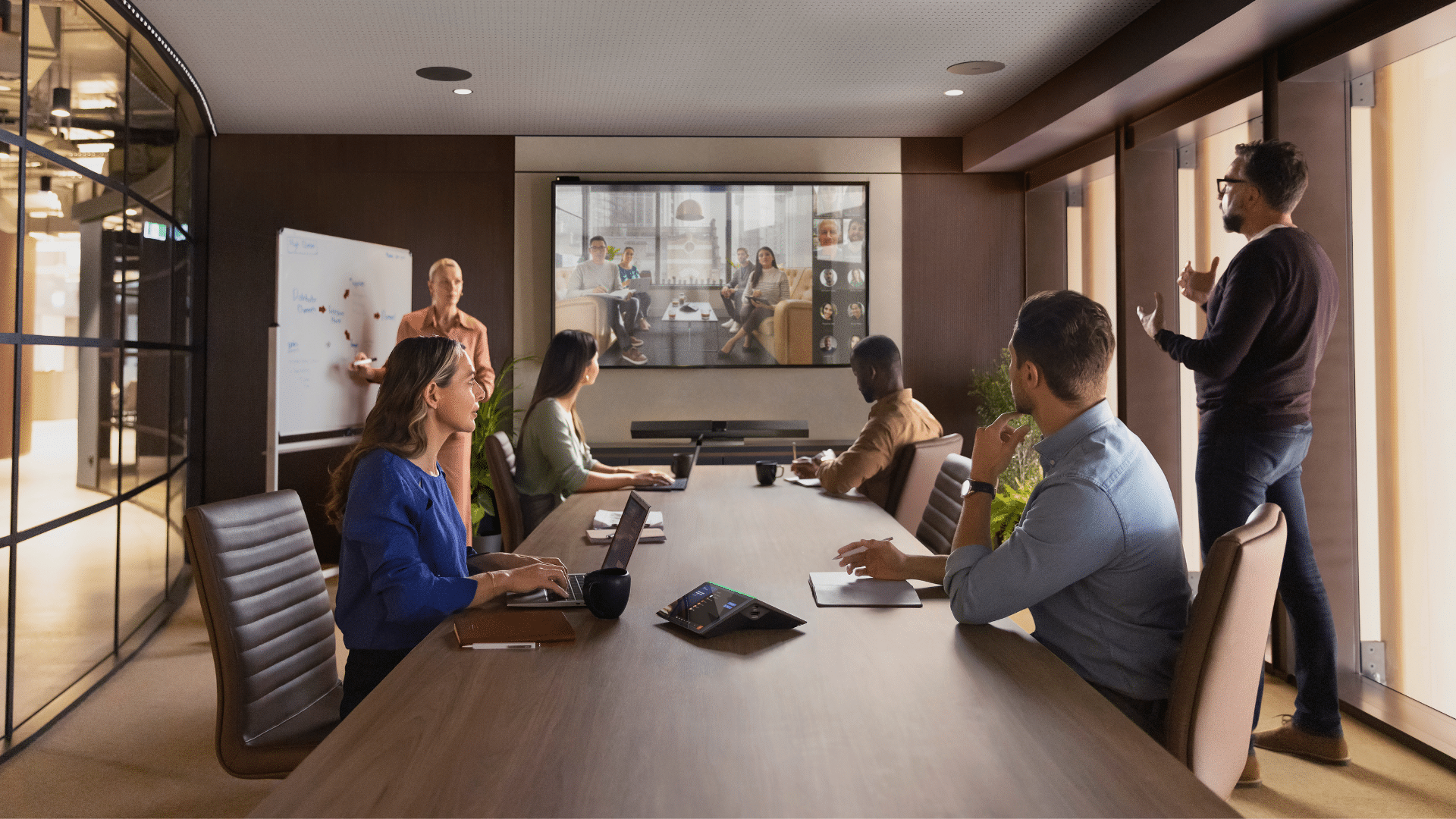
Modern workspaces include meeting spaces specifically designed for hybrid collaboration. These rooms often include intelligent cameras that track speakers, large digital displays for shared content, and integrated video conferencing systems.
Many organisations discover that the biggest challenge is making sure all the components work together seamlessly. Screens, cameras, microphones, and employee devices all need to integrate into a system that is easy to use. Systems that are difficult to use or unreliable can quickly become a source of frustration.
Research from Gartner suggests that poor workplace technology creates digital friction that erodes workplace productivity.
This is where a combined office fitout and workplace technology approach becomes valuable. By designing the physical space alongside the technology infrastructure, businesses can create seamless environments, making it easier for everyone in (and outside) of the office.
4. Restorative Spaces for Employee Wellbeing
There is an increasing awareness around the importance of supporting employees and their well-being. Restorative spaces provide areas where employees can step away from their desks, recharge, and reset during the workday.
These areas might include comfortable seating, soft lighting, and sound-absorbing design features to create a calm environment where employees can decompress between tasks.
One great example is Medibank Place in Melbourne, where the workplace was designed to support employee wellbeing. The office includes informal breakout areas, quiet spaces, and access to natural light throughout the building to help employees recharge during the day.
By incorporating restorative spaces into an office fitout, organisations can create a more balanced, health-focused workplace where employees can manage their energy levels and stay focused throughout the day.
Redesigning Offices as Living Work Ecosystems
The shift from traditional offices to modern workplaces is not about adding the latest furniture or technology. It reflects a broader shift in how organisations think about the office’s purpose.
Many companies have begun redesigning their offices as living work ecosystems. Even smaller businesses can create effective work zones through thoughtful office fitouts and smart use of existing space.
The goal is to create an environment that employees cannot easily replicate at home. The energy of working alongside colleagues, the ability to solve problems together quickly, and comfortable environments that invite people in.
For organisations navigating hybrid work, the workplace is becoming a strategic asset. For HR leaders and operations teams, the conversation around return-to-office should no longer be about policy. It should be about creating workplaces that offer real value to employees.
Organisations that rethink their office environments are not just improving the aesthetic of their physical workplace. They are strengthening many aspects of office-based work that can influence long-term business performance.
Creating Future-Ready Workplaces with Integrated Fitouts and Technology
Successful offices combine workplace design and technology, so every part of the environment works seamlessly.
This is where a complete office fitout approach becomes valuable.
At Mitronics, we deliver modern office fitouts across Sydney and Australia, combining strategic workplace design with integrated technology. From commercial office fitouts and furniture solutions to interactive displays, video conferencing systems, and AI-ready workstations, the goal is to create connected environments that support today’s ways of working.
For organisations rethinking their return-to-office strategy, the workplace itself can become a powerful driver of improved company culture. Whether it’s creating micro-zones or integrating technology to improve hybrid meetings and digital workflows, office design strategy can transform how your team interacts in the workplace.
If you’re planning an office upgrade or workplace redesign, speak with the Mitronics team today to explore how a modern office fit-out can help.
Disclaimer: This article may include AI-generated or AI-assisted images created for visual representation and informational purposes only. These images are intended to enhance user understanding and may not depict real-world objects, individuals, or scenarios.

Roger Amir is the Director of Mitronics Corporation Australia, a leading provider of Office Equipment Supplies, Technology, Photocopiers, and Managed IT Services. He oversees strategic operations, helping Australian businesses optimise their workflows and drive productivity. Roger’s expertise focuses on tailored technology strategies, document management, and business efficiency. Connect with him on LinkedIn.