


In today’s fast-moving digital landscape, every business – from local clinics to national enterprises – relies on technology to function efficiently. Payments, customer data, cloud applications, cybersecurity, even basic day-to-day operations all depend on reliable IT systems. When technology slows or stops working, productivity, revenue, and customer trust can suffer.
That’s why many Australian organisations are turning to Managed IT Services. Instead of having an in-house IT department or reacting to issues as they arise, businesses can partner with a Managed IT Service provider who takes care of their systems around the clock. From cloud hosting and data protection to helpdesk support and hardware updates, these experts keep your technology running behind the scenes.
In this guide, we’ll break down what managed IT services are, their benefits, key service types and how to choose the right provider to support your organisation’s success.
Click to read the section:
- What Are Managed IT Services?
- What are The Benefits of Managed IT Services?
- How Managed IT Services Work to Support Daily Operations?
- How Managed IT Frees Up In-House Staff for Core Tasks?
- What Do IT Managed Service Providers (MSPs) Do?
- Advantages and Disadvantages of IT Managed Services
- Commonly Used Managed IT Services
- Industries Best Suited for Managed IT Services
- How to Choose the Right Managed IT Services Provider in Australia?
What Are Managed IT Services?
Managed IT Services are a proactive approach to maintaining your business’s technology systems. Instead of waiting for something to go wrong and paying for repairs, companies partner with a Managed IT Services provider (MSP) who continually monitors, manages, and secures their networks, devices, and cloud environments.
This model replaces the old break-fix approach with ongoing support designed to prevent issues before they happen. MSPs use advanced monitoring tools to identify performance risks, apply updates, and strengthen cybersecurity – all before your team even notices a problem. For Australian businesses where uptime, compliance, and data protection are essential, this proactive approach saves money and stress.
The Role of Service Level Agreements (SLA)
Every Managed IT partnership is backed by a Service Level Agreement (SLA) – a contract outlining the scope of support, guaranteed response times, and uptime commitments. This ensures accountability and measurable results. An SLA basically gives you the confidence that your technology will stay operational and that any disruptions will be handled quickly.
A Managed Service Provider (MSP) acts as a long-term IT partner, not just a technician who shows up when something breaks. MSPs work closely with your business to understand your goals, implement the right solutions, and plan for future growth. From network monitoring to cybersecurity and cloud management, they make sure your IT setup supports your business, so your people can focus on what they do best.
Pro tip: For many Australian organisations, outsourcing IT management offers a strategic edge. It reduces internal workload, mitigates risk, and provides access to enterprise-grade technology without enterprise-level costs.
What are The Benefits of Managed IT Services?
Partnering with a Managed IT Services provider (MSP) is a cost-effective and efficient way to manage your business’s technology. Whether you’re managing five employees or five hundred, outsourcing IT management can help you operate more efficiently, protect your data, and stay focused on growth.
Below are five major benefits that make Managed IT services one of the smartest investments for Australian organisations.
1. Cost Savings
Outsourcing IT management helps businesses save significantly on staffing and infrastructure costs. There’s no need to maintain a full-time IT department or invest heavily in hardware, software, and maintenance. Managed IT Services replace unpredictable repair bills with predictable monthly fees, making budgeting easier and more consistent.
A key financial advantage lies in the shift from a capital expenditure (CapEx) model to an operational expenditure (OpEx) model.
- CapEx requires large, upfront investments in servers, equipment, and software licenses.
- OpEx, on the other hand, spreads costs over time through monthly payments.
This transition allows businesses to preserve cash flow, scale resources easily, and avoid the depreciation costs associated with physical infrastructure. Reduced downtime, thanks to proactive maintenance, further contributes to long-term savings.
According to Deloitte’s 2024 SMB Technology Outlook, over 60% of Australian SMEs say predictable IT costs are a top reason for adopting managed services – a trend driven by tighter margins and higher demand for reliability.
2. Reliability Through Proactive Monitoring
Managed IT Services use 24/7 system monitoring to identify issues before they cause downtime. Your provider uses advanced tools to detect slow performance, failed backups, or potential security risks, often fixing them remotely before staff even notice.
This proactive approach helps ensure uninterrupted operations and prevents costly productivity losses. For industries like healthcare, legal, or construction – where uptime directly affects clients or project timelines – this reliability is invaluable.
3. Expert Support and Access to Latest Technology
A Managed IT Services partnership gives you on-demand access to certified professionals across networking, cybersecurity, and cloud computing. These specialists help you adopt the latest technologies-from secure cloud platforms to modern collaboration tools-without the stress of researching, testing, or deploying them internally.
Because MSPs service many clients, they stay ahead of tech trends and vendor updates, allowing your business to benefit from enterprise-grade expertise without the enterprise-level price tag.
4. Security and Data Protection
Cyberattacks cost Australian businesses more than $46,000 on average per incident (source: ACSC Annual Cyber Threat Report 2024). Managed IT providers help reduce that risk with layered protection, including firewalls, endpoint security, data encryption and compliance audits.
For sectors bound by strict regulations, such as healthcare, law, and finance, MSPs also ensure compliance with Australian data privacy laws and ISO/IEC 27001 security standards. With regular monitoring and backup strategies, your data stays protected and recoverable at all times.
5. Reduced Downtime
Proactive monitoring and maintenance help prevent system failures before they occur. MSPs detect potential issues early, minimizing costly downtime that can disrupt business operations. Continuous network monitoring also ensures faster response times and quicker recovery from technical issues.
6. Access to Expertise
MSPs employ certified professionals with experience across different industries and technologies. This provides your business with access to a wide range of IT skills, including cybersecurity, data management, and cloud solutions, without the need to hire multiple specialists internally.
Types of Managed IT Service
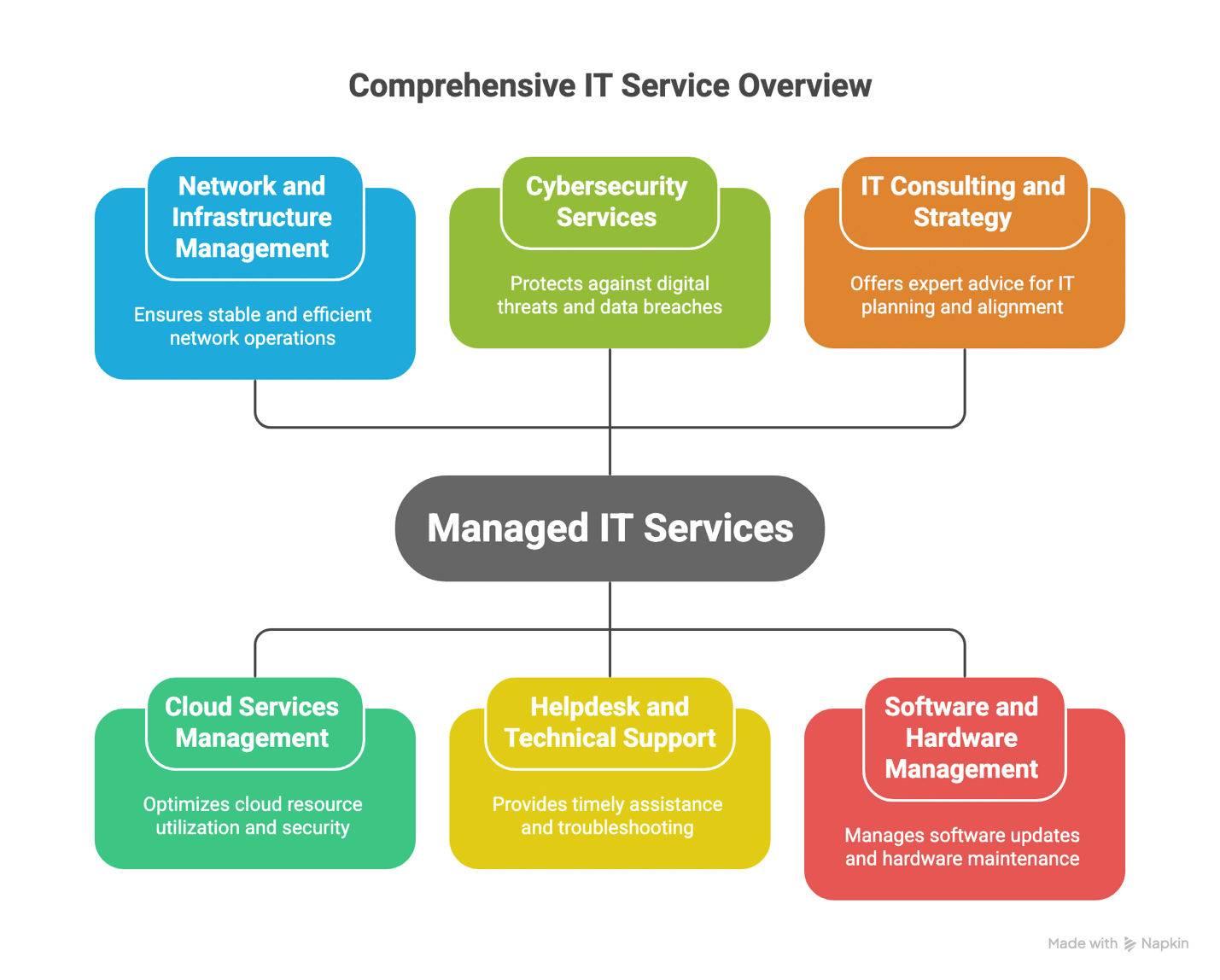
Not all Managed IT Services are the same. The right provider will tailor their offering to match your organisation’s size, industry, and goals. From cloud migration to cybersecurity and helpdesk support, Managed IT Services give Australian businesses access to the kind of technology infrastructure once reserved for only large enterprises – without the overhead.
Here are the main types of Managed IT Services that keep modern businesses secure and stable.
1. Network and Infrastructure Management
Your network is the backbone of your business. Managed network services cover everything from server configuration and VPN setup to 24/7 network monitoring. The goal is to maintain uptime, prevent outages and ensure your team can connect securely – whether they’re in the office or working remotely.
Example: A Sydney-based engineering firm uses a Managed IT provider to monitor bandwidth across multiple sites, preventing slowdowns and ensuring reliable access to design files stored in the cloud.
2. Cloud Services Management
Cloud adoption has surged in Australia with over 80% of SMEs now using cloud-based tools (ABS Digital Economy Report, 2024). Managed IT providers help businesses migrate, secure, and optimise their cloud environments.
Example: A legal practice in Melbourne uses cloud-based document management and email hosting, with its MSP handling compliance and encryption automatically.
3. Cybersecurity Services
Cybersecurity services protect business data and systems from cyber threats which are evolving faster than ever. Managed security services give businesses enterprise-grade protection through firewalls, real-time threat detection, multi-factor authentication, and vulnerability testing.
Example: A retail chain relies on its MSP’s 24/7 security monitoring and backup recovery system to protect sensitive customer payment data and maintain compliance with PCI DSS standards.
4. Helpdesk and Technical Support
When technical issues arise, helpdesk services provide fast, remote troubleshooting for staff. Most providers offer multi-channel support – via phone, chat, or ticketing systems – to resolve software errors, password resets, and connectivity problems quickly.
Example: A healthcare clinic’s staff contact their MSP helpdesk to fix an EMR login issue within minutes, avoiding costly appointment delays.
5. IT Consulting and Strategy
Beyond maintenance, MSPs act as strategic partners – helping align technology investments with long-term business objectives. They help with IT planning, advising on cloud strategy, cybersecurity roadmaps, and compliance frameworks such as ISO 27001 and HIPAA.
Example: A national construction company partners with its MSP to plan a three-year IT roadmap that supports new site expansions and integrates IoT monitoring devices.
6. Software and Hardware Management
Keeping technology current is a constant challenge. MSPs manage software licences, automate updates, and monitor device performance to ensure your systems remain secure and compliant.
Example: An accounting firm’s MSP deploys updates across all workstations after hours, ensuring zero disruption to client work the next morning.
The Value of a Tailored Approach
No two Australian businesses are alike. The most effective Managed IT Service providers offer a custom mix of the above functions – scaling support as your organisation grows. Whether you’re seeking a full-service IT partner or co-managed support for your existing team, the goal is the same: secure, reliable technology that powers your business forward.
Explore further: Learn how Mitronics delivers tailored Managed IT Services to fit your business goals. See our Managed IT solutions →
How Managed IT Services Keep Your Business Running Smoothly.
The best IT support Is the kind you barely notice. Behind the scenes, Managed IT Services keep your systems, networks, and applications running – so your people can focus on running the business.
Using advanced monitoring tools, your MSP tracks performance across servers networks, and devices in real time. When a potential issue arises – such as a storage overload or a patch failure – an automated alert triggers an immediate fix, often before anyone in the office notices a slowdown.
This proactive model contrasts sharply with traditional break-fix IT support. Instead of waiting for problems and downtime, Managed IT keeps your operations stable and your teams productive around the clock.
How Managed IT Services Work to Support Daily Operations?

The best IT support is the kind you barely notice. Behind the scenes, Managed IT Services keep your systems, networks, and applications performing at their best—so your team can focus on running the business, not fixing it.
Using real-time monitoring and automated alerts, your Managed IT Services provider (MSP) tracks performance across servers, networks, and devices.
If something starts to go wrong- a patch fails, storage fills, or a network slows – your MSP acts immediately, often before anyone in the office realises there’s a problem.
This proactive, prevention-first model is what separates Managed IT from traditional “break-fix” support. Rather than reacting to downtime, your MSP maintains continuous uptime, faster recovery, and a secure, stable environment that keeps your business moving forward.
By combining automation, expert oversight, and strategic planning, Managed IT Services transform technology from a source of stress into a silent driver of efficiency, reliability, and growth.
How Managed IT Frees Up In-House Staff for Core Tasks?
One of the biggest advantages of partnering with a Managed IT Services provider is time. Instead of losing hours to troubleshooting or routine maintenance, your staff can focus on the initiatives that drive your business forward – customer experience, growth and innovation.
A Managed IT Services provider takes care of all the time-consuming tasks, such as software updates, network monitoring, and system maintenance. They handle the technical side of things, so your in-house team doesn’t have to get bogged down in the details.
This model also helps prevent burnout among internal IT staff. Rather than firefighting system outages or resetting passwords all day, they can lead transformation projects – such as migrating to the cloud or improving digital workflows. The result is a more productive, motivated team supported by a reliable external partner.
In short, Managed IT Services give your business both efficiency and breathing room – keeping technology seamless and freeing your team to focus on what they do best. It’s a smarter, more scalable way to work.
What Do IT Managed Service Providers (MSPs) Do?
A Managed Service Provider (MSP) is far more than a helpdesk or technician on call. They act as your outsourced IT department – responsible for keeping your technology secure, reliable, and aligned with your business goals.
At the core of their service is proactive management. MSPs continuously monitor your systems, identify risks, and resolve issues before they affect operations. Instead of reacting to failures, they prevent them—minimising downtime and protecting productivity.
But great MSPs go beyond maintenance. They provide strategic technology guidance, helping you plan upgrades, adopt new tools, and scale your infrastructure as your business grows.
For example, they might help an accounting firm transition to secure cloud hosting, or design a disaster recovery plan for a construction company managing multiple sites.
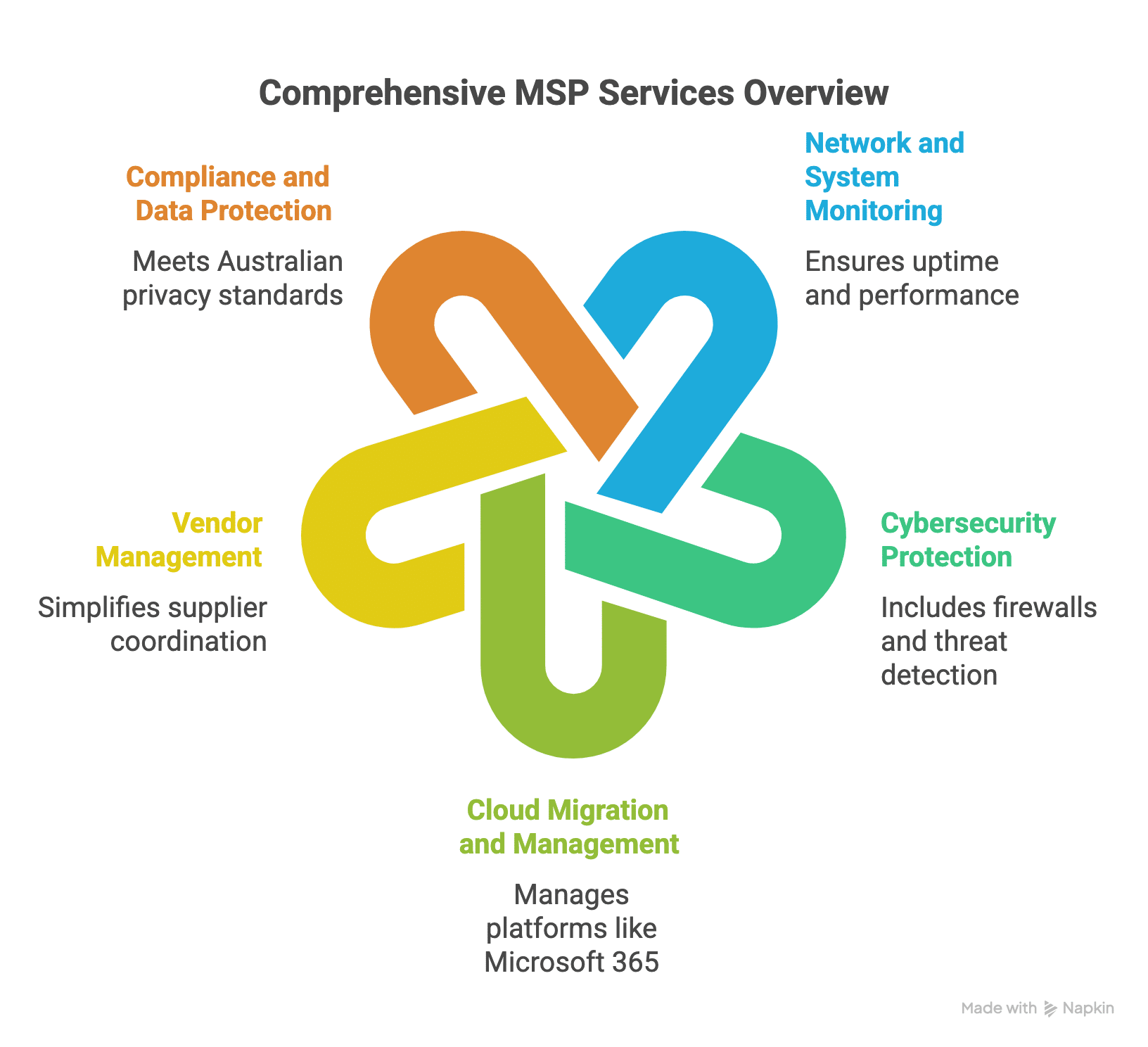
Most Managed IT Services providers in Australia offer:
- Network and system monitoring to maintain uptime and performance.
- Cybersecurity protection, including firewalls, threat detection, and staff training.
- Cloud migration and management for platforms like Microsoft 365 or Google Workspace.
- Vendor management, so you don’t have to juggle multiple software and hardware suppliers.
- Compliance and data protection, ensuring your business meets Australian privacy standards.
In short, an MSP functions as both your IT guardian and strategic advisor – combining technical expertise with business insight. By partnering with a trusted provider, your organisation gains the confidence that every system, server, and device is working towards one goal: helping your business grow securely and efficiently.
Advantages and Disadvantages of IT Managed Services
Like any business solution, Managed IT Services comes with both pros and cons. Understanding them helps you make an informed decision about whether this approach is suitable for your organization.
| Advantages | Disadvantages |
|---|---|
| Reduced operational costs – Managed IT Services can be more cost-effective than maintaining a full in-house IT team. You pay a set monthly fee instead of unpredictable repair bills. | Dependency on external providers – Your business relies on an outside team for system management and issue resolution. |
| Scalable IT infrastructure – Services can easily grow with your business, adding users, devices, or storage without major upgrades. | Less direct control – Outsourcing means your internal team may have less hands-on control over certain systems and settings. |
| Round-the-clock monitoring – MSPs continuously monitor your network 24/7 to detect and resolve issues before they cause downtime. | Requires trust and a strong SLA – It’s important to work with a provider that offers clear Service Level Agreements and transparency. |
| Stronger cybersecurity posture – MSPs use advanced tools and best practices to protect against data breaches and cyber threats. | Possible communication or time zone challenges – Offshore providers can sometimes lead to delays or misunderstandings. |
Industries That Benefit Most from Managed IT Services
Almost every industry today relies on technology to stay productive, efficient, and competitive. From retail to construction, the right Managed IT Services provider helps Australian businesses stay connected, secure, and productive – without the stress of managing complex systems internally.
Here’s how Managed IT transforms operations across key industries.
- Retail: Managed IT keeps inventory systems accurate, ensures POS terminals stay online, and protects customer data from breaches. Retail businesses can focus on delivering a great customer experience while their technology runs smoothly behind the scenes.
- Law Firms: Lawyers depend on secure document management and strict confidentiality. MSPs help legal firms stay compliant with privacy laws and keep sensitive client data safe from cyber threats.
- Construction: With construction teams often spread across job sites, cloud collaboration tools and mobile workforce connectivity are essential. Managed IT helps project managers share files, track progress, and stay connected in real time.
- Healthcare and Medical Practices: Patient information must be protected under strict data privacy laws. MSPs ensure HIPAA compliance, patient data security, and 24/7 access to essential healthcare systems like clinics and hospitals.
- Security Firms: Managed IT supports CCTV integrations, alarm systems, and real-time monitoring to ensure smooth and reliable operations. Proper data storage ensures video and security logs are safely archived.
- Nonprofits (NFPs): MSPs offer budget-friendly IT solutions that enable nonprofits to manage donor data, run efficient campaigns, and reduce overhead costs.
- Manufacturers: Managed IT enhances automation, facilitates IoT integration, and enables equipment monitoring, allowing manufacturing factories to stay productive with minimal downtime.
- Schools and Education: From e-learning platforms to student data protection, managed IT services help schools and education institutes run reliable networks and maintain secure digital environments for students and staff.
- Accounting and Finance: These businesses handle large volumes of sensitive data. Managed IT services ensure data security, backups, and compliance with financial regulations, preventing costly breaches and downtime.
While some industries rely more heavily on technology than others, any organization that utilizes computers, networks, or cloud systems can benefit from managed IT support. By partnering with Mitronics, businesses gain peace of mind knowing their systems are secure, efficient, and ready to support growth.
How to Choose the Right Managed IT Services Provider in Australia?
Choosing the right Managed IT Services provider can make all the difference in how smoothly your business runs. Mitronics is a reliable provider and a true partner who understands your goals and helps your technology grow with you.
Before signing a contract, consider the following key factors:
1. Proven Experience and Certifications
Look for a provider with a track record across your industry—whether that’s healthcare, construction, or finance. Certifications from major vendors like Microsoft, Cisco, and AWS indicate technical expertise and adherence to global best practices.
2. Clear Service Level Agreements (SLAs)
A strong SLA defines response times, uptime guarantees, and accountability. It’s your assurance that issues will be resolved quickly and performance will be measurable. Transparent SLAs reflect a provider’s confidence and professionalism.
3. Security and Compliance Expertise
Your MSP should meet Australian cybersecurity and privacy standards, including compliance with the Privacy Act 1988 and the Essential Eight Maturity Model recommended by the Australian Cyber Security Centre (ACSC). Ask about their approach to backups, encryption, and incident response.
4. Scalability and Flexibility
Choose a provider that can grow with you. Whether you’re opening new offices, onboarding remote staff, or moving to the cloud, your Managed IT Services should scale seamlessly without disrupting operations.
5. Local Presence and 24/7 Support
A local team means faster on-site response when needed and a deeper understanding of your region’s connectivity and compliance requirements. For national or hybrid operations, confirm that your MSP provides round-the-clock monitoring and a dedicated support line.
6. Transparent Pricing and Reporting
Avoid surprises by choosing a provider with clear pricing models and detailed reporting. Regular reports should outline performance metrics, system health, and cost efficiencies achieved—so you always know the value being delivered.
7. Client Reviews and Case Studies
Testimonials and industry case studies show how well a provider performs under real-world conditions. Look for success stories from Australian businesses similar to yours—it’s one of the best indicators of reliability.
Pro Tip: Before you commit, ask your potential MSP how they handle data sovereignty, remote support, and disaster recovery. Their answers will reveal not just technical capability but also the level of care they’ll bring to your business continuity.
Mitronics combines national coverage with local expertise—delivering transparent pricing, responsive support, and solutions tailored to Australian business needs.
Talk to our IT specialists →
Why Choose Mitronics for IT Managed Services
When it comes to Managed IT Services in Australia, Mitronics stands out for one simple reason—we treat your technology as if it were our own. Our goal isn’t just to fix problems but to help your business run smarter, safer, and more efficiently every day.
With more than two decades of experience supporting Australian organisations, Mitronics delivers tailored IT solutions designed for how you actually work. Whether you’re managing multiple retail sites, a professional services firm, or a healthcare network, our local specialists provide both on-site and remote support to keep your operations running seamlessly.
Our end-to-end service covers every aspect of IT management:
- Network setup and optimisation for stable, secure connectivity.
- Cybersecurity protection with proactive monitoring and compliance checks.
- Cloud hosting and data backup for flexibility and business continuity.
- Hardware and software maintenance to extend the life of your tech investments.
With Mitronics, there are no hidden costs or complex contracts – just transparent, predictable pricing and a team that’s accountable for performance.
Partner with Mitronics to simplify your IT, enhance productivity, and protect your business from unexpected downtime.
Get in touch today for a free IT assessment.
Conclusion
Managed IT Services provide businesses with professional support for monitoring, maintaining, and optimising technology systems. They help prevent downtime, improve security, and allow internal teams to focus on core tasks.
Outsourcing IT to a Managed Service Provider gives access to specialised skills, proactive monitoring, and scalable solutions. This approach is especially valuable for businesses operating in healthcare, retail, law, education, and other industries that rely heavily on technology.
By partnering with an experienced provider like Mitronics, Australian businesses gain a local partner committed to performance and long-term success.