


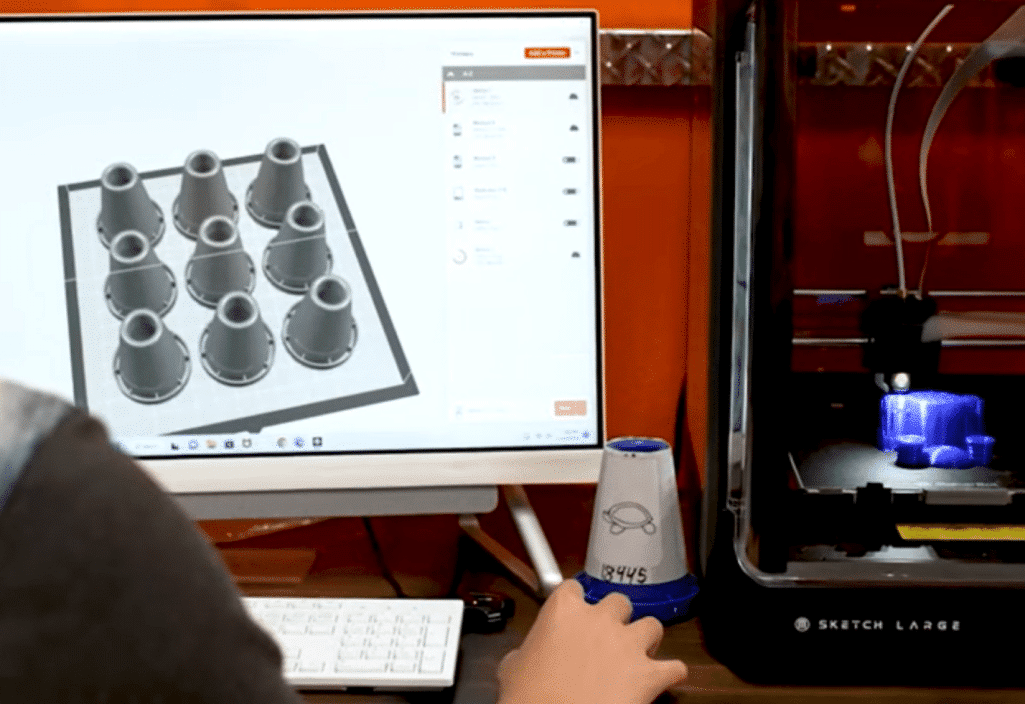
Unlike traditional printing methods, which often result in excess waste, 3D printing allows for more efficient, accurate, and customisable production. In recent years, Australian businesses have increasingly turned to this 3D printing technology to boost innovation and reduce costs.
From manufacturing and healthcare to education, architecture and product prototyping, industries across the country are discovering the advantages of 3D printing. It supports faster design cycles, helps reduce overheads and enables the creation of complex components that were previously difficult or expensive to produce.
Table of Contents:
- What Is 3D Printing?
- The Basics of How 3D Printers Work
- Types of 3D Printing Technologies
- Key Components of a 3D Printer
- Materials Used in 3D Printing
- 3D Printer Filament Types and Their Uses
- Advantages and Challenges of 3D Printing (Pros & Cons)
- The Future of 3D Printing in Australia
- Buy, Rent, or Lease 3D Printers in AU from Mitronics
What Is 3D Printing?
3D printing, or additive manufacturing, is a modern production method where objects are built one layer at a time based on a digital design. Instead of cutting or molding materials like in traditional manufacturing, 3D printers add material precisely where it’s needed.
The result? Less waste, faster turnaround, and more flexibility.
Using a 3D printer, you can create just about anything. Here’s what businesses can make out of 3D printers.

- In business settings, it’s often used for rapid prototypes, replacement parts, tools, and even packaging components.
- Architects can print detailed scale models, while engineers use it to test designs before full-scale production.
- In healthcare, it’s used for custom prosthetics and surgical guides.
- Even in classrooms, students use 3D printers to bring ideas to life with hands-on learning tools
Whether you’re making a one-off concept model or a short production run, 3D printing offers a smart, flexible way to turn digital ideas into real-world solutions.
The Basics of How 3D Printers Work
At its core, 3D printing is straightforward once you break it down.
- 3D Modelling (CAD)- First, you need a 3D model of the object you want to print. This is usually created using CAD (Computer-Aided Design) software, where you design the object on your computer. Common file formats include STL and OBJ, which are compatible with most 3D printers.
- Slicing- Next comes slicing. A slicing program takes your 3D model and chops it into thin horizontal layers. It also sets the path the printer’s nozzle will follow to build each layer. Once that’s done, the file is sent to the 3D printer.
- Printing process- During the 3D printing process, the machine lays down material (usually plastic or resin) layer by layer, slowly building your object from the bottom up.
- Post-processing- Finally, there’s post-processing. This step can include removing support structures, sanding rough edges or curing resin prints for extra strength. It all depends on the material and the finish you’re after.
Types of 3D Printing Technologies
There are a few key types of 3D printing technologies, each suited for different business needs and applications.
FDM (Fused Deposition Modelling)
3D printing is the most common and affordable type. It works by heating and extruding thermoplastic filaments layer by layer to create objects. FDM printers are great for rapid prototyping, concept models, and even light commercial use. If you’re a design studio or a small manufacturing unit, FDM is a reliable, cost-effective starting point.
SLA (Stereolithography)
3D printing uses a UV laser to cure liquid resin into hardened plastic. It produces highly detailed and smooth prints, making it ideal for applications like dentistry, jewellery design, and product prototypes where finish and precision matter.
SLS (Selective Laser Sintering)
3D printing is a step up for functional parts. It uses a laser to fuse powdered materials, usually nylon, without needing support structures. This makes it perfect for complex mechanical parts, custom fittings, and durable end-use components.
DMLS/SLM (Direct Metal Laser Sintering or Selective Laser Melting)
3D printing takes things further by printing with metal powders. Used heavily in aerospace, automotive, and medical industries, these printers can create strong, complex metal parts directly from CAD files.
You might also come across AMS (Active Material Switching) 3D printing, a newer approach that allows switching between materials or colours during a single print. It works well with FDM 3D printing systems and boosts flexibility in product development.
Key Components of a 3D Printer

Here’s a quick breakdown of the essential hardware parts that make a 3D printer tick:
- Print head / Nozzle: Heats and deposits melted filament material layer by layer to build the object.
- Extruder: Feeds the filament into the nozzle with consistent pressure for smooth and accurate printing.
- Build platform: The surface where the object is printed. Heated platforms help improve adhesion and reduce warping.
- Stepper motors: These motors control the movement of the print head and build platform along the X, Y, and Z axes for precision.
- Control board: The printer’s brain. It processes the design file and manages all hardware operations in sync.
These components work together to transform digital designs into physical, tangible prints, perfect for Aussie businesses looking to prototype or produce in-house.
Materials Used in 3D Printing
When it comes to 3D printing for industrial or office use, the choice of material really depends on what you’re printing and the performance you need. The most common materials include thermoplastics like PLA, ABS, and PETG. These are great for general-use prototypes and parts thanks to their flexibility and ease of printing.
Resins, used mainly in SLA or resin printers, offer high detail and smooth finishes, making them ideal for design models or dental and jewellery applications. Metals, such as stainless steel, titanium, and aluminium, are used in more advanced, industrial-grade machines for strong, functional parts.
There are also biodegradable filaments like PLA, which are popular in schools and offices for their eco-friendliness. Overall, 3D printing materials range from polymers and composites to metals, depending on the need for strength, durability, flexibility, or environmental responsibility.
3D Printer Filament Types and Their Uses
When it comes to 3D printing, choosing the right filament makes a big difference.
- PLA is one of the most popular options. It’s biodegradable, low-odour and great for office use or general-purpose prints.
- ABS is tougher and more heat-resistant, making it ideal for creating strong parts used in engineering or product development.
- If you need something that can handle moisture or wear and tear, PETG is your go-to. It’s water-resistant and perfect for mechanical or outdoor parts.
- Lastly, TPU is a flexible filament that’s used for prints that need to bend or stretch, like phone cases or gaskets. Each material has its perks, so it depends on what your project needs.
Real Applications of 3D Printing in Australian Business & Industries
Beyond hobbyist creations, 3D printing has become a transformative B2B tool across Australia, driving innovation and on-shore manufacturing capabilities.
In advanced manufacturing, companies use the technology for rapid prototyping and creating specialised tooling. Firms like SPEE3D are developing world-leading metal 3D printing for defence and industry.
The healthcare sector has seen many examples of 3D printing applications. The CSIRO has been at the forefront, developing patient-specific solutions like a 3D-printed titanium sternum implant. While the Royal Brisbane and Women’s Hospital (RBWH) uses 3D printing for ocular prosthesis, or artificial eye, as per the abc.net.au article.
This customisation extends to other industries. Architecture firms routinely produce detailed scale models for client visualisation, while in the high-performance automotive sector, Supercars teams like Erebus Motorsport 3D print custom parts to gain a competitive edge.
In education, universities such as RMIT integrate additive manufacturing into their curriculum, providing students with hands-on learning tools for design and engineering.
These real-world applications showcase how the 3D printing technology offers tangible, specialised value to Australian organisations.
Advantages and Challenges of 3D Printing (Pros & Cons)
| Advantages of 3D Printing | Challenges of 3D Printing |
| Faster prototyping: Quickly turn ideas into working models without waiting weeks. | Material limitations: Not all materials can be printed, and some aren’t suitable for end-use. |
Cost-effective small runs: Perfect for low-volume production without costly tooling. | Print time: Larger or complex prints can take hours, even days, to finish. |
Customisation & complexity: Easily print detailed, unique, or intricate designs tailored to your needs. | Initial setup cost: Quality 3D printers can be pricey. |
On-demand manufacturing: No need to store large inventories. Just print what you need, when you need it. | Skill requirement: A bit of training is needed to design and run prints properly. |
Whether you’re just starting or scaling up, 3D printing has plenty to offer; just plan smartly around the few hurdles.
The Future of 3D Printing in Australia
3D printing in Australia is on a serious growth curve. According to recent reports, the market is expected to grow at a CAGR of 8.7% between 2023 and 2030. That’s a strong indicator that this tech isn’t just a trend; it’s becoming a core part of how industries build and innovate.
We’re also seeing a major uptake in sectors like aerospace, defence, medical tech and renewable energy. From custom medical implants to lightweight aircraft parts, Aussie companies are already tapping into the versatility of 3D printing. It’s not just about creating objects either, many are using it to repair, customise and cut production time in half.
What’s even more exciting is how 3D printing is starting to merge with artificial intelligence (AI) and robotics. This combo is pushing the boundaries, making manufacturing smarter, faster, and more precise, according to an industry report. The way things are shaping up, 3D printing is set to play a huge role in the future of advanced manufacturing in Australia.
Buy, Rent, or Lease 3D Printers in Australia from Mitronics
Looking to bring 3D printing into your business?
Mitronics makes it easy with flexible buy, rent, or lease options tailored to suit your needs. Whether you’re after a long-term investment or just want to trial 3D printing for a specific project, we’ve got you covered. Our rental and leasing plans are ideal for Australian businesses wanting to stay agile without a big upfront cost.
Plus, you’ll get ongoing support from our local experts, servicing, and advice to keep your printer running smoothly. We’ll also help you choose the right 3D printer to fit your workflow and budget.
Ready to get started? Contact us for a custom quote designed for your business needs.