


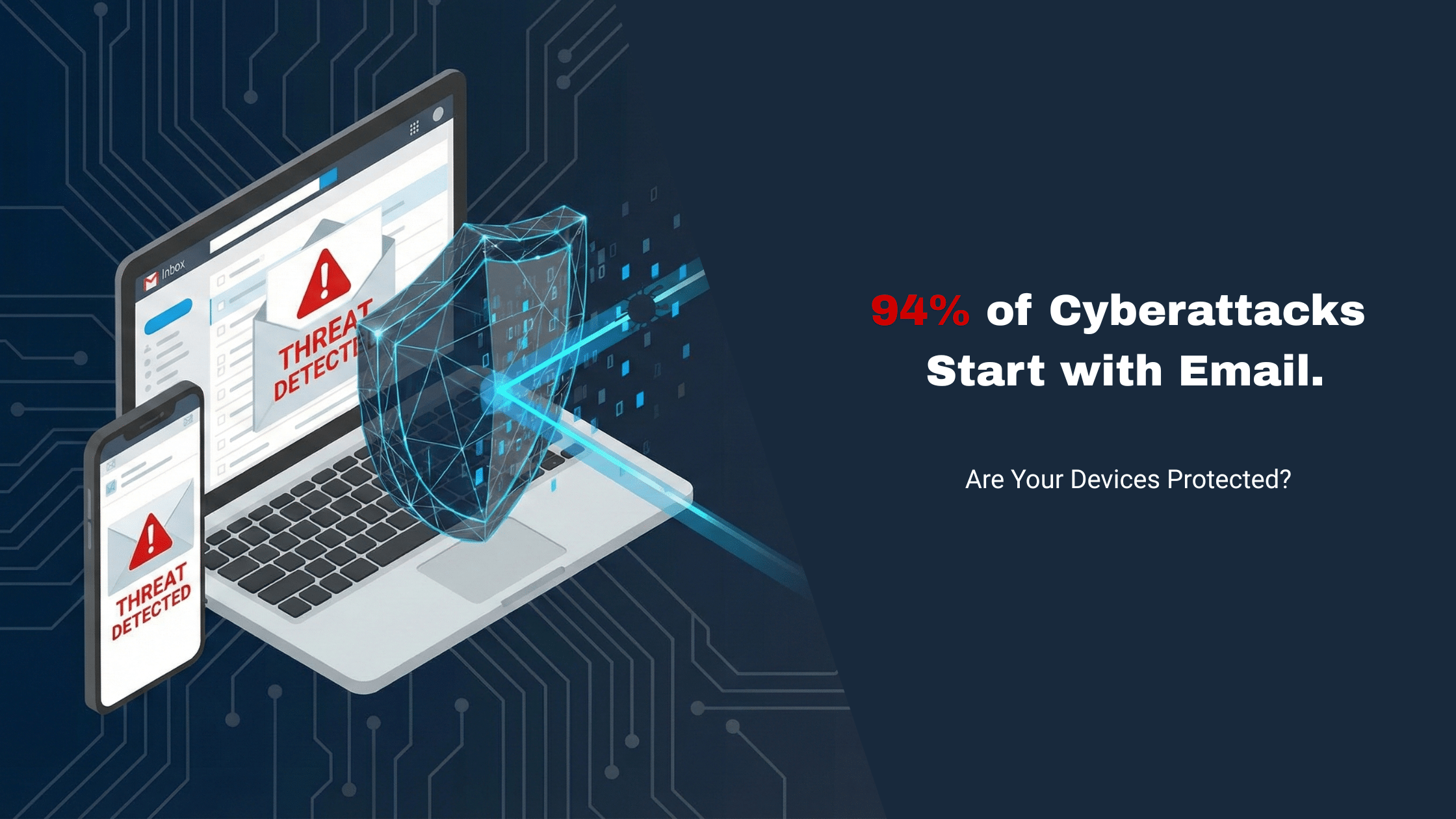
Most cyberattacks don’t begin with complex system breaches. They begin with an email.
A routine-looking invoice, shared document, or delivery update can contain links or attachments that silently deploy malware, steal credentials, or launch ransomware once opened. In fact, around 94% of cyberattacks are delivered via email, making it a primary entry point for attackers.
This is why endpoint security is a critical part of modern cyber defence. Protecting the inbox alone is no longer enough. Australian businesses now need endpoint security solutions that prevent threats from running in the first place.
Why is Email Targeted in Cyberattacks?
Email remains a common starting point for cyberattacks because it is so deeply embedded in business activity across Australia and the world.
Cybercrime groups have become highly skilled at crafting emails that look completely legitimate, so even cautious users can be tricked.
Attackers constantly adapt their techniques to bypass email filters. This is why even well-configured email security and filtering tools can’t stop every threat. As a result, some malicious emails may inevitably reach inboxes, even in well-protected environments.
Once a link is clicked or an attachment is opened, the attack spreads beyond the inbox and to the device itself. This transition from email to endpoint is where malware can execute and spread across systems.
This is why modern security strategies go beyond email alone and focus on protecting endpoints.
What is Endpoint Security and Why Does it Matter?
Endpoint security protects the devices people use to work from cyber threats.
An endpoint is any device that connects to business systems or data, such as laptops and desktops. Because these devices are where emails are opened, they’ve become the primary targets of modern cyberattacks.
Endpoint security focuses on stopping malicious activity at the device level. It prevents harmful files or links from running in the first place.
In today’s working environment, employees aren’t always at their desks. Laptops and phones move between homes, offices, cafes, airports, and client sites. This means security can no longer depend on a single network or location. What matters most is how well the device itself is protected.
The Limits of Traditional Antivirus and Detection-Based Security
For a long time, antivirus (AV) software was the backbone of business security. Relying on signatures and behaviour patterns, traditional antivirus tools could block threats when they appeared.
Modern attacks, however, are often new and fast-moving. Designed to avoid detection. When a threat arrives via email, it may not match a known signature or clear pattern of malicious behaviour at first.
By the time AV flags it, it may already be too late. The malicious code may already have been executed on the device. Once a threat is running, the damage may already be underway. Credentials can be captured, and ransomware can start moving across systems.
This is why endpoint security is shifting away from detection-only models. Instead of waiting for threats, prevention-first approaches focus on stopping risky activity before it can even run. In environments where employees are opening emails, attachments, and links every day, stopping threats before they execute is by far the most effective approach.

This image was generated using AI for illustration purposes and may contain inaccuracies.
A Modern, Zero-Trust Approach to Endpoint Security Solutions
So what is a prevention-first model?
This modern approach assumes that not every file, link, or attachment can be trusted. This is known as Zero Trust at the endpoint. Regardless of whether it comes from within or outside the organisation, files and links are treated as risky until proven safe, reducing the risk of hidden threats running unchecked.
Modern endpoint security basically isolates risky activity. Email attachments and downloads can be opened in secure environments that prevent malicious code from interacting with the operating system or network. If a file turns out to be harmful, it can be contained quickly.
Most importantly, this occurs without disrupting how people work. Users can continue opening emails and browsing the web as they always do, while security operates quietly in the background.
Containing Email-Based Threats with HP Sure Click Enterprise
While email is the most common entry point for cyberattacks, the real risk lies in whether links or attachments are clicked. This is where HP Sure Click Enterprise, which is part of the HP Wolf Security portfolio, comes in.
HP Sure Click Enterprise uses hardware-enforced isolation to contain risky activities such as web browsing and opening email attachments. When a user opens an email attachment or clicks a link, the content is opened in a secure environment. In simple terms, even if a malicious link is clicked, it’s trapped before it can do any damage.

The Risk of Lost or Stolen Devices
Not every risk comes from a malicious email.
Lost and stolen laptops are another major concern, especially for hybrid and remote teams.
When a laptop goes missing, most employees worry about the cost of replacement. But what they should be worried about is the security risk.
Business laptops often store saved passwords, email access, cached data, and connections to internal systems. If a device falls into the wrong hands, attackers may gain access to sensitive data and critical applications.
For small and medium-sized businesses, this is particularly concerning as they often have less room to absorb the financial and operational impact of a data breach. A single compromised device can cause disruption that goes well beyond the cost of replacing the hardware. The impact of a data breach is stark. Sometimes, attacks are so damaging that they can completely destroy a business.
Take MediSecure as an example. In 2024, the Melbourne-based digital prescription provider suffered a major ransomware attack, resulting in approximately 12.9 million Australians’ personal data being stolen and posted on the dark web. It even caused the company to enter voluntary administration and liquidation as it was unable to recover from the financial fallout.
While not caused by a lost device, it illustrates how damaging modern attacks can be when sensitive data is exposed.
Regaining Control with HP Wolf Protect and Trace
Modern endpoint security works best when multiple protections operate as part of a single, unified approach. HP Wolf Security is designed to help organisations quickly respond when Windows-based Premium HP devices go missing by enabling teams to find, lock, and remotely erase them.
Powered by HP TechPulse and hardware-enforced persistence, it maintains protection even if an attacker attempts to tamper with the device.
With HP Wolf Protect and Trace, IT can:
- Locate devices remotely by using the HP TechPulse dashboard to issue a “Find” command over the internet.
- Lock devices immediately by sending a “Lock” command to block access for unauthorised users.
- Erase devices if recovery isn’t possible using the “Erase” command to securely wipe data from the PC.
Layered Endpoint Security That Works Together
No single security control can stop every threat. That’s why modern endpoint security works best when multiple layers are working together, with each part addressing a different part of the attack chain.
As we have now learnt, although email is the most common entry point for cyberattacks, the real damage happens when a threat reaches the device. Layered endpoint security focuses on stopping the attack at both points.
How Layered Endpoint Security Reduces Risk
- Email-driven threats with device-level containment
Even if a malicious link or attachment lands in an employee’s inbox, device-level security can isolate it before it reaches the system.
- Centralised management and visibility
IT teams can monitor device security from a single platform. This makes it easier to manage distributed workforces and respond quickly to incidents.
- Reduced IT workload through automation
Automated protection and response help to lighten the load for IT teams. This allows them to focus on strategic work rather than constantly monitoring potential threats.

This image was generated using AI for illustration purposes and may contain inaccuracies.
Layered endpoint security provides strong protection without relying on users to always make the right decisions or on IT teams to manage every alert. By working together, these security layers help ensure threats are contained early so that businesses can continue operating with confidence.
Mitronics’ Role in Supporting Endpoint Security
Choosing the right endpoint managed IT security solution is only part of the equation. Making sure it’s set up correctly and aligned with how your team actually works is important.
Mitronics supports Australian businesses in understanding their risk profile and existing IT environment. This ensures security decisions are based on real-world needs, and not assumptions. From there, endpoint security solutions like HP Wolf Security can be deployed to best support and protect your working environment.
Our goal is simple: help Australian businesses stay secure as the way we work evolves.
Related read: Why Mitronics Stands Out in Sydney’s Office Technology Market
Want to Review Your Endpoint Security?
If you’re unsure how well your devices are protected against modern threats, now could be a good time to review your endpoint security.
Mitronics can help you understand whether your current setup is built for today’s email-driven, AI-powered attacks – and where HP Wolf Security can help strengthen your defences.
Get in touch with the Mitronics team to discuss endpoint security solutions tailored to your business.

Roger Amir is the Director of Mitronics Corporation Australia, a leading provider of Office Equipment Supplies, Technology, Photocopiers, and Managed IT Services. He oversees strategic operations, helping Australian businesses optimise their workflows and drive productivity. Roger’s expertise focuses on tailored technology strategies, document management, and business efficiency. Connect with him on LinkedIn.